
Where Is your Core?
I wanted to invite you to a new class I have starting this Saturday 10:30 at our new space in Cheadle Hulme at Rise Fitness. Booking is through the website as usual but I wanted to give you more details on how this class will differ from my other practices.
Firs of all, its flow based. The rhythm will be slow and steady so it’s accessible for all & in May we are focusing on the core. And I want to start by saying this.
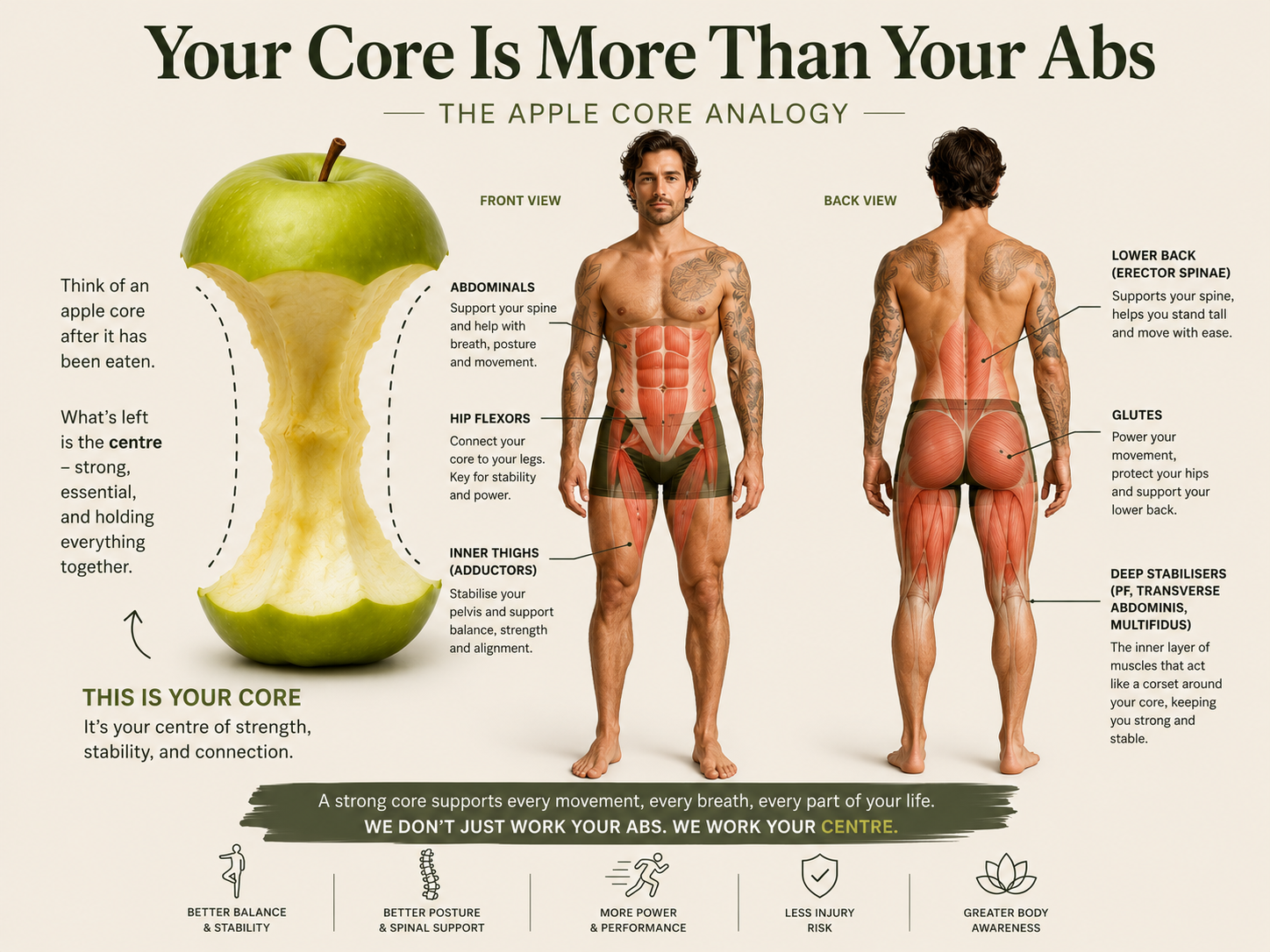
Your core is not just your abs.
That is where most people’s mind goes. Six-pack muscles, crunches, planks, that familiar burning feeling at the front of the body. But the truth is, there isn’t one universal definition of the core. Different teachers, therapists, movement coaches, and strength trainers may all describe it slightly differently.
For me, the simplest way to understand it is to think of an apple core. When the sides have been eaten, what is left?
The centre.
That is how I want us to think about the human core. Not as one muscle. Not as something you train just to look good. Not as an isolated part of the body. Your core is the centre of your movement.
It includes the abdominals, yes, but also the obliques, lower back, glutes, hip flexors, inner thighs, pelvic floor, diaphragm, and deep stabilising muscles that help organise the body from the inside out.
When your core works well, movement feels more connected.
You balance better.
You transition more smoothly.
You twist with more control.
You protect your lower back.
You move with more confidence.
You feel stronger without having to force everything.
This is why core strength matters so much in yoga.
In flow practice, the core helps you step forward from Downward Dog, stabilise in standing balances, control transitions, support backbends, and move through stronger postures without collapsing into the wrists, shoulders, hips, or lower back.
Wait there’s more!
The physical benefits are usually the first reason we book a class, but I don’t think they are the main reason anyone stays with yoga. And as many of you know, my drive as a teacher is to uphold the deeper, spiritual elements of yoga, while making them accessible, grounded, and less otherworldly. You do not need to take a huge leap of faith to experience what yoga is pointing towards.
So, when I was building this new class, I wanted to think about what the word core means on a deeper level.
And I think it is about feeling centred.
Because we all know what it feels like to be pulled out of our centre. To feel dragged away from ourselves. Stress can pull us out of our mental centre. Relationships can pull us out of our emotional centre. Pain, injury, tiredness, and tension can pull us out of our physical centre. That is why this month’s focus is the core. Not just the abs. The centre.
So when we train the core in yoga, we are not just trying to make the body stronger. We are practising the feeling of coming back to ourselves.
In class, that might look like holding a strong posture and staying with the breath. It might look like moving slowly enough to feel where the work is really coming from. It might look like finding steadiness in a balance, or staying present when the body starts to shake a little.
And there’s a real body intelligence to this practice because a strong core is not rigid. It is responsive. It knows when to engage, when to release, when to stabilise, and when to adapt. That is the kind of strength we are building this month.
And, as always, we will close class with deep rest, using progressive relaxation and gentle hypnosis-informed techniques to help the body settle, the breath soften, and the mind quieten.
So you get both sides of practice.
Effort and ease.
Strength and surrender.
Focus and rest.
This month, we train the core.
Not just the abs.
The centre.
Join me for Saturday Flow Yoga, 10:30 to 11:30am.
Click below and claim a free trial class.