Why Sun Salutations Might Be the Most Complete Practice in Yoga
Many modern yoga class seems to begin the same way.
You stand at the top of the mat.
Hands together.
A slow breath in.
Then the movement begins.
Fold forward.
Step back.
Lift the chest.
Push the hips high.
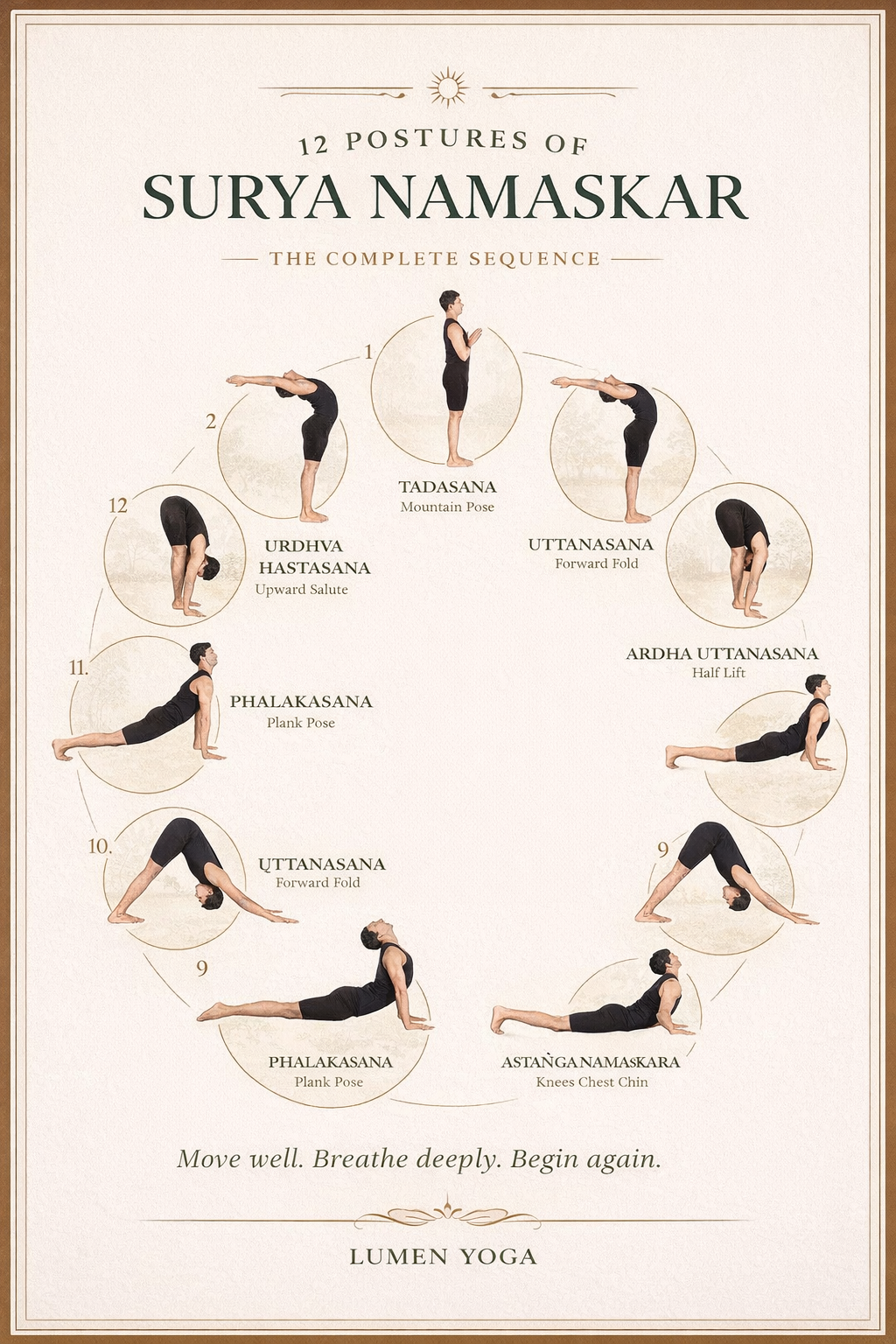
Within minutes the body warms, the breath becomes more intentional, and the mind becomes quieter. This flowing sequence is known as Sun Salutations, or Surya Namaskar, and it has quietly become one of the most recognisable practices in modern yoga.
This month in classes I have been teaching versions of the sequence, but here’s the interesting thing.
What many people treat as a simple warm-up may actually be one of the most complete movement practices ever created. And modern research is beginning to confirm what yogis have known for centuries.
Modern science is beginning to notice
Yoga practitioners have known for a long time that Sun Salutations are pretty special. Now researchers are beginning to look more closely at why.
Studies looking at the practice show that when the sequence is practised continuously it can elevate heart rate enough to act as a moderate cardiovascular workout. In other words, those flowing rounds of yoga are not just stretching the body. They are training the heart and lungs too.
Other research has found improvements in strength, endurance, flexibility and mobility when Sun Salutations are practised regularly. This makes sense when you look at the movement. The sequence asks the body to support weight through the arms, stabilise through the core, and move the spine through flexion, extension and lengthening.
There is also growing evidence that yoga practices combining movement with breath can help regulate stress and support attention and mental clarity.
You may have felt this yourself in class. After a few rounds the mind chatter slows down and you feel engaged and warm but also focused and present.
Why this simple sequence works so well
Part of the brilliance of Sun Salutations is their simplicity. In a matter of minutes you are training several systems in the body at once. The muscles become stronger as they support your weight through plank and downward dog. The joints move through a wide range of motion as you fold, step and extend. The breath becomes deeper and more rhythmic as it guides the flow.
And slowly, almost without trying, attention returns to the present moment.
There is nothing mystical about this. It is simply what happens when breath, movement and attention start working together. Which is why so many teachers say that if you had to keep only one practice from yoga, Sun Salutations would be a very good place to start.
The deeper side of the practice
Traditionally Sun Salutations were practised at sunrise. Not as a workout, but as a gesture. A quiet acknowledgement of the light that begins the day. Each movement becomes a small act of gratitude. Breathing in. Breathing out. Rising and folding with the rhythm of life itself.
Whether or not we think about the symbolism, something of that feeling still remains in the practice. It wakes the body, it steadies the breath and it helps us arrive in the day with a little more clarity.
Sometimes that is exactly what we need.