
Sauna Culture and Detox Conversations
Heat exposure, microplastics, and real wellness benefits
Half term isn’t just quieter roads and a slower pace. It also seems to be when people suddenly have time to ask curious questions. One of the hottest topics I’ve come across recently is sauna culture. Not the kind of wellness tip that’s a fad, hopefully by now you know I’m not a fad person. Despite the GenZ style name, “sauna culture,” I think there’s something in this for the rest of us too so lets dig in.
Can sitting in heat really do more than make you sweat?
Can it actually change what’s in your blood?
And does it matter for nervous system regulation, recovery, ageing, and long-term health?
Bryan Johnson’s sauna experiment and microplastics
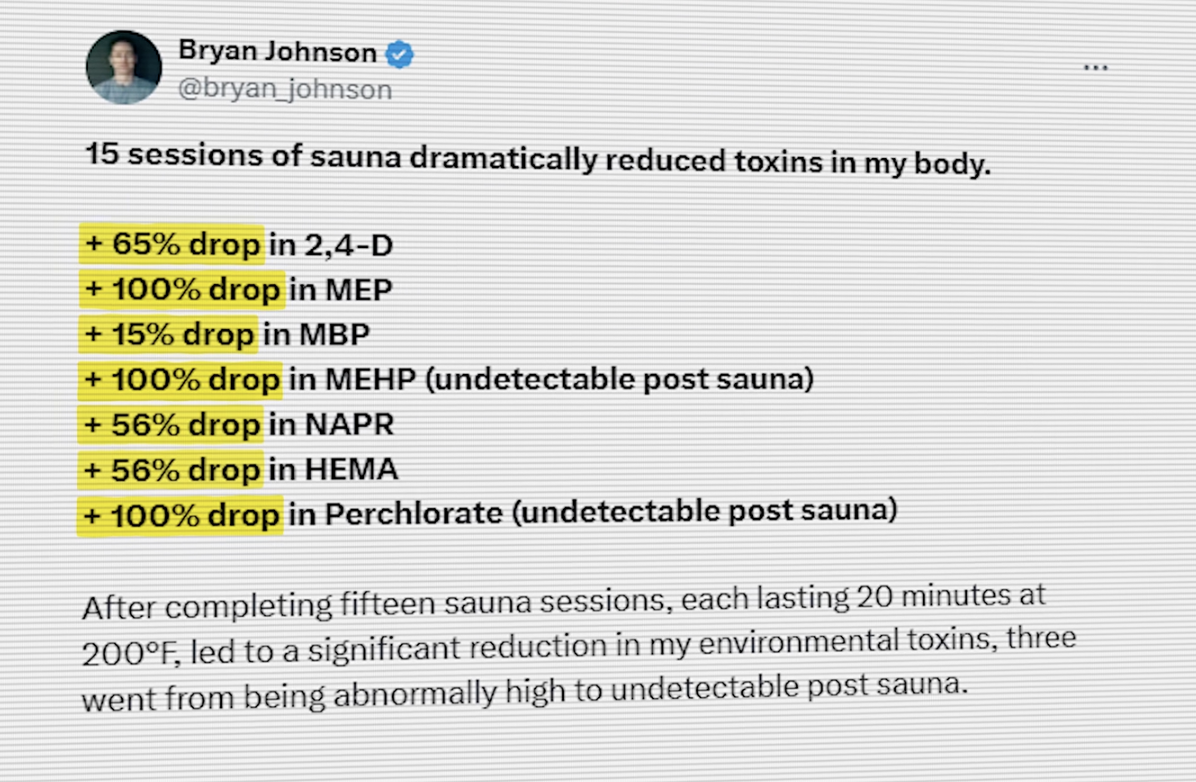
Longevity enthusiast Bryan Johnson has become well known for self-tracking experiments. Recently he shared data from a personal protocol involving regular sauna use and blood testing for microplastics. According to his tests, his blood microplastic count dropped by around 85% % in just 30 days. These results are so radical it’s hard to believe them and it rightly makes headlines. Now here’s the honest tilt: this is not a controlled scientific study. It’s a personal experiment with many variables. We don’t yet have peer-reviewed data showing that sauna use reliably clears microplastics from the blood in most people. Claims like that are interesting, and they point to something worth studying, but they are not conclusive evidence yet.
What stronger evidence says about sauna and health
Where the science is robust is in long-term observational data on traditional sauna use and disease risk.
Large European studies, particularly data from the Kuopio Ischemic Heart Disease Risk Factor Study in Finland, show compelling associations:
People who used a traditional Finnish sauna 2–3 times per week had lower risks of cardiovascular mortality and hypertension compared to those reporting sauna use once per week or less.
More frequent use (4–7 times weekly) was linked with progressively larger reductions in the risk of cardiovascular and all-cause mortality.
In these same data, higher sauna frequency also corresponded with lower risks of dementia and Alzheimer’s disease.
What’s happening here is not fully understood, but researchers point to several mechanisms that make sense biologically: heat exposure triggers protective cardiovascular responses, increases blood flow, improves endothelial function, reduces inflammatory markers, and stimulates heat shock proteins that support cellular resilience.
Some of these adaptations like mild increases in heart rate and circulation, mirror what happens in moderate exercise. That doesn’t make sauna a replacement for movement, but it does mean it’s doing more than just warming your skin.

Traditional sauna vs red-light or infrared
If your gym, health club or home has an option of sauna type then for me there is a clear winner. Saying that, all of them offer benefit and I would say to use what you have access to. Before I offer my opinion, I’ll address the elephant in the room for those that know me well. The “bio-hacking” craze does make me shudder & cringe. Time after time their claims prove to be unsubstantiated and the very idea that we can solve the problems created by tech, by investing more tech is a clear marketing scheme in my mind. So it’s fair to say I have a bias for nature of industry. That said I’ll be honest enough to admit if I’m wrong so let’s dive into the evidence.
The best evidence we have in humans comes from studies of traditional saunas, high temperature, dry or low-humidity heat, like the ones used in Finland. The large longevity and cardiovascular datasets I just mentioned are almost exclusively about these traditional heat exposures.
Infrared and red-light saunas operate at lower ambient temperatures and heat the body differently. There are some promising small studies suggesting benefits, particularly for relaxation and circulation, but they do not yet have the volume of long-term health data that traditional saunas do. So far independent studies show red-light and infrared saunas can’t get you above the 150 threshold that is needed to receive the benefits of a traditional sauna. You might have been told differently, but a scholar deep dive (please don’t use google for studies - and remember question all the tech bio hacking bros who are trying to sell you the latest miracle cure), will show the tech sauna claims are not independently accepted. It may well be that in time these new technologies display similar outcomes, but for now traditional sauna is the one we know works.
So if your goal is cardiovascular health, cognitive benefits, or long-term disease reduction, the evidence points more strongly to traditional hot sauna sessions, ideally combined with social connection, hydration, and a movement practice you actually enjoy.
Bottom line
Personal experiments like Bryan Johnson’s are interesting, and they can inspire questions. But they are not definitive proof that sauna use detoxifies microplastics in everyone.
The better evidence is the association between regular traditional sauna use and reduced risks of cardiovascular disease, dementia, hypertension, and other lifestyle-related conditions.
Traditional heated saunas (higher temperatures, dry or mild humidity) are where most of the good data is right now. Red-light / infrared options may still have value, they just need more study.
This whole space fits into a bigger idea in wellness: stressors that mimic mild challenge (heat, movement, breath, cold exposure) appear to promote resilience when applied safely and consistently.
If you’ve got access to a sauna this week, enjoy it, and pay attention to how your body responds. That subjective experience combined with the evidence is the real conversation worth having.
See you tomorrow.
Stuart
Sauna is a stressor. And like all stressors, it’s beneficial when applied safely and in the right dose for you.
Sauna Contraindications and Cautions
Sauna can be a powerful tool for recovery and cardiovascular health, but it is not appropriate for everyone. If you are unsure, speak to your GP before using heat exposure regularly.
Do not use a sauna if you:
Are pregnant
Have unstable or severe cardiovascular disease
Have recently had a heart attack without medical clearance
Have uncontrolled high blood pressure
Have severe aortic stenosis
Are experiencing acute infection with fever
Are severely dehydrated
Have heat stroke history without medical supervision
Have epilepsy that is not well controlled
Are under the influence of alcohol or recreational drugs
Use caution and seek medical advice if you:
Have controlled hypertension
Have cardiovascular disease but are medically stable
Have autonomic dysfunction or fainting episodes
Take medications that affect blood pressure, heart rate, or fluid balance
Take diuretics
Have kidney disease
Have diabetes with neuropathy
Are elderly and prone to dizziness
Have multiple sclerosis or heat sensitivity conditions
General safety guidelines
If cleared to use sauna:
Start with shorter sessions, 5 to 10 minutes
Build gradually toward 15 to 20 minutes
Hydrate well before and after
Exit immediately if you feel dizzy, nauseous, faint, or unwell
Avoid combining with alcohol
Allow your heart rate and blood pressure to settle before driving